The Evolution of PV Module Efficiency

As solar power has moved into the mainstream of global energy production, the efficiency of photovoltaic (PV) modules has risen steadily. Since the early commercial deployments, year-on-year gains in efficiency have been accompanied by a sharp fall in costs. These trends reflect both the rapid scaling of manufacturing and sustained improvements in production techniques, which have allowed higher-performance modules to be produced at ever lower cost.
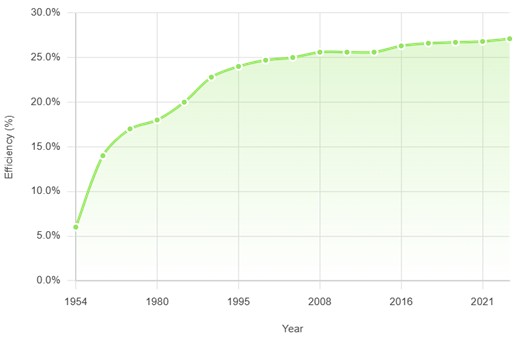
Recent advancements in efficiency
More recently, the industry has begun to shift from mono-PERC modules to TOPCon technology. TOPCon cells offer higher conversion efficiencies, with laboratory results reaching around 26.5 per cent, compared with typical mono-PERC efficiencies of approximately 22.5 per cent. The higher performance comes at the cost of a more complex and capital-intensive manufacturing process. Even so, TOPCon has been adopted rapidly and is now emerging as a new industry standard. In short, TOPCon is more efficient because it wastes less energy inside the cell, but it is harder and more expensive to manufacture than mono-PERC.
The future of PV Modules
Perovskite solar modules are emerging as a potential next step in the evolution of photovoltaic technology. Using a different class of light-absorbing materials from conventional silicon, perovskites can be manufactured at lower temperatures and with thinner layers, offering the prospect of high efficiencies with reduced material use. Laboratory results have shown rapid efficiency gains over a short period, particularly when perovskites are combined with silicon in tandem designs. Module manufacturers have reported module efficiency over 34% in lab tests. However, challenges around long-term stability, durability and large-scale manufacturing remain, meaning perovskite modules are still some distance from widespread commercial deployment.
Effects on New and Existing Solar Projects
When projects are repowered, lower-efficiency modules may be replaced with newer, higher-efficiency alternatives. While this can increase power output, it can also introduce constraints related to grid connection limits and inverter compatibility. Careful design is therefore essential to ensure that technology choices align with the project’s electrical infrastructure and its ability to accommodate higher capacity.
For new projects, advances in module technology are largely beneficial. Higher-efficiency modules allow the same energy output to be achieved from a smaller footprint, reducing land use and costs associated with structural and civil works. These savings, however, may be partly offset by higher module procurement costs, particularly for newer technologies.
Overall, rising module efficiencies are reshaping solar project economics, delivering clear advantages for new developments while requiring careful technical and commercial assessment for repowering existing assets. As technologies advance, the balance between higher performance, system compatibility and cost will remain central to project design decisions.